Are history books cooked?
While we were going through COVID and the October 7th war, the idea of living through historical times, and how current events would be remembered in the future, kept popping up in the back of my mind and in conversations around me.
History books, history classes at school, documentaries, history podcasts, and conversations with loved ones and acquaintances kept coming to mind. Because that’s how I learned about history.
And yet, with the AI revolution we’re going through, our understanding of what it means to live through history might be fundamentally shaped by a medium that’s about to change.
If future generations get something like Asimov’s Chronoscope, and given the current trajectory, I suspect they will, then perhaps we’re getting something fundamentally wrong about how we think about living through great changes.
We’re imagining how future generations will look back at our present through the lens of how we learned about the past, even as technology is transforming that very lens.
I just tried a little experiment. I asked ChatGPT to reconstruct a random Tuesday during the first year of the war. Its first attempt described school drop-offs, work meetings, and news in the background. But it missed so much. The faces of the hostages everywhere, the yellow ribbons, the fear of rockets and sirens, and the guilt that accompanied even the smallest celebrations. I had to keep correcting it, adding details from our lived experience.
Even with GPT-6, the difference between the first and last drafts was stark. And that was with someone who lived through it correcting the reconstruction. What happens when there’s nobody left to make those corrections?
Feel any difference?
First draft:
A random Tuesday in the first year after October 7th might not look dramatic from the outside. The morning would begin with school drop-offs, traffic, WhatsApp messages, and work meetings. Maybe there had been a difficult headline overnight, or another name released, or another report from the north or Gaza. People would notice, talk about it for a few minutes, maybe carry a quiet heaviness with them, and then continue with the ordinary demands of the day. Coffee had to be made, dishes had to be washed, errands still existed, and emails still kept arriving.
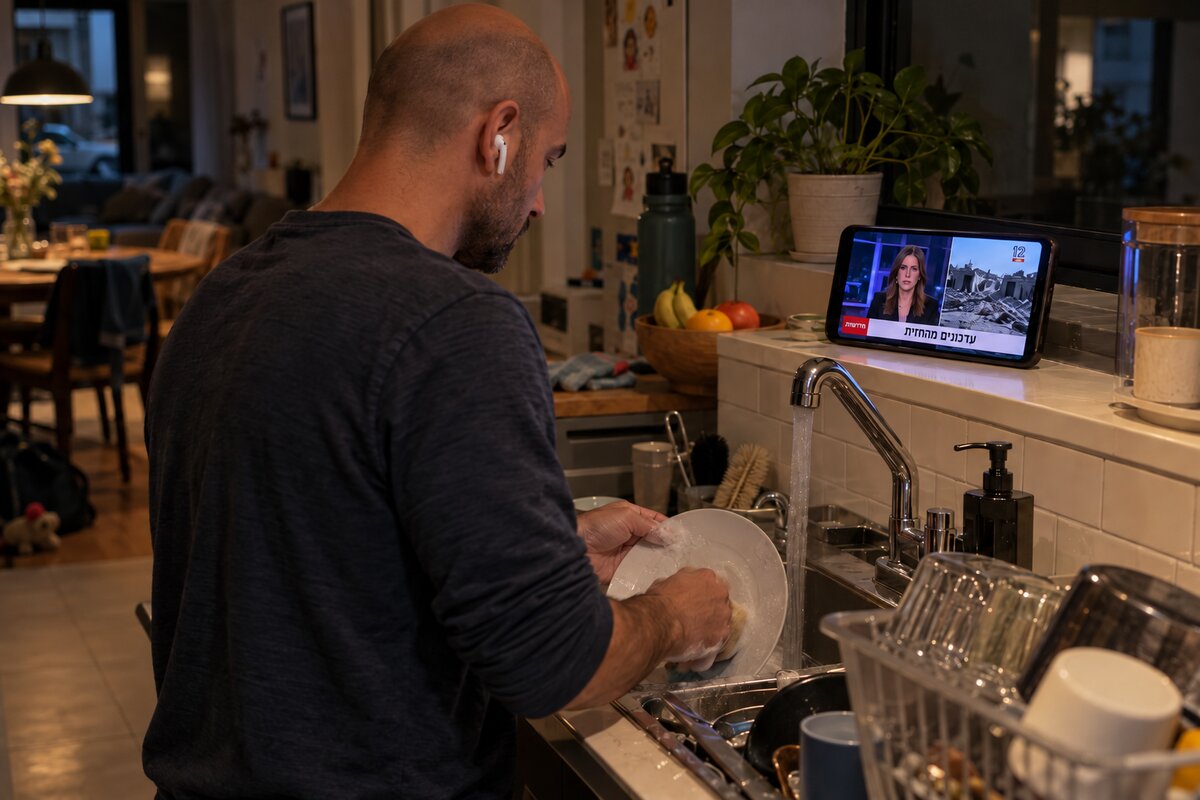
By the afternoon or evening, that same Tuesday might feel suspended between two realities. In one reality, history was unfolding, and everyone knew it. In the other, the sink was full, the kitchen light was on, and someone stood washing plates while glancing again and again at updates on their phone. Channel 12 would be on, not because every update changed everything, but because it was impossible not to keep checking. The war was not always a siren or a headline. Sometimes it was simply the background hum of life, present in the room even when all you were doing was the dishes.
And maybe that is what people in the future will struggle to grasp: that historical times do not always feel historical in every moment. Sometimes they feel like an ordinary Tuesday, with the weight of history resting quietly on the counter beside the soap and the running water.
Fourth draft:
It was a Tuesday morning in 2024. The kids needed to get to school and kindergarten, there was traffic, and another day of work lay ahead. But for parts of that year, even getting the children to school involved worrying about rockets and sirens. What if a siren sounded on the way? Would the children be safe at school? And everywhere you looked, there were faces. Photographs of the hostages at intersections, on walls, outside schools and businesses. Yellow ribbons on cars, balconies, and people’s clothes. The demand to bring them all home, now, was everywhere. Every day that passed was another day they weren’t home.
At work, life continued. Meetings, deadlines, coffee breaks, conversations about the latest news. People talked about the hostages, the soldiers, the fighting, the government, and what might happen next. Projects moved forward, groceries needed buying, and children still had birthdays. But even celebrations carried guilt. How could you celebrate while your brothers and sisters were being held in tunnels beneath Gaza, while young women, some barely 19, were feared to be suffering sexual violence in captivity? Even moments of joy were shadowed by the knowledge of what others were enduring. There was no escaping it, and perhaps no desire to escape it entirely.
That evening, in the kitchen, the dishes were piling up. Channel 12 was playing on a phone beside the sink. Another interview with a hostage’s family, another update from the fighting, another discussion about a possible deal. You listened while washing dishes, occasionally stopping to look at the screen. Tomorrow would probably be much the same. And all the while, you knew that for the families waiting for their loved ones, there was nothing ordinary about any of it.